Fedwire vs ACH: Speed, Cost & Which Method to Use (2026)

TL;DR - Summary
- What is Fedwire? - Fedwire, formally the Fedwire Funds Service, is a real-time gross settlement system operated by the 12 Federal Reserve Banks for large-value, time-sensitive domestic USD transfers, and it settles each payment individually in minutes rather than in batches.
- What is ACH? - ACH (Automated Clearing House) is an electronic network governed by Nacha that moves money between US bank accounts through batch processing, with standard settlement taking 1 to 2 business days and fees of $0.20 to $1.50 per transfer.
- How do Fedwire and ACH compare on cost? - Fedwire costs $25 to $35 on the sender’s side plus up to $20 for the recipient’s bank, while ACH costs just $0.20 to $1.50 and is typically free for the recipient, so ACH is far cheaper but slower.
- Which method should Indian exporters use? - ACH suits routine, lower-value invoices because it minimises the client’s transaction costs, while Fedwire is better for high-urgency, high-value B2B settlements where same-day finality matters, and either way funds reach India through a virtual USD account and a SWIFT conversion leg.
What Is Fedwire and How Does It Work?
Fedwire, formally the Fedwire Funds Service, is a real-time gross settlement (RTGS) system operated by the 12 Federal Reserve Banks in the United States, built for large-value, time-sensitive domestic USD transfers. Unlike ACH's batch processing, it handles each payment individually and settles it instantly, so once a Fedwire transfer goes through, the money moves in minutes with no waiting or batching.
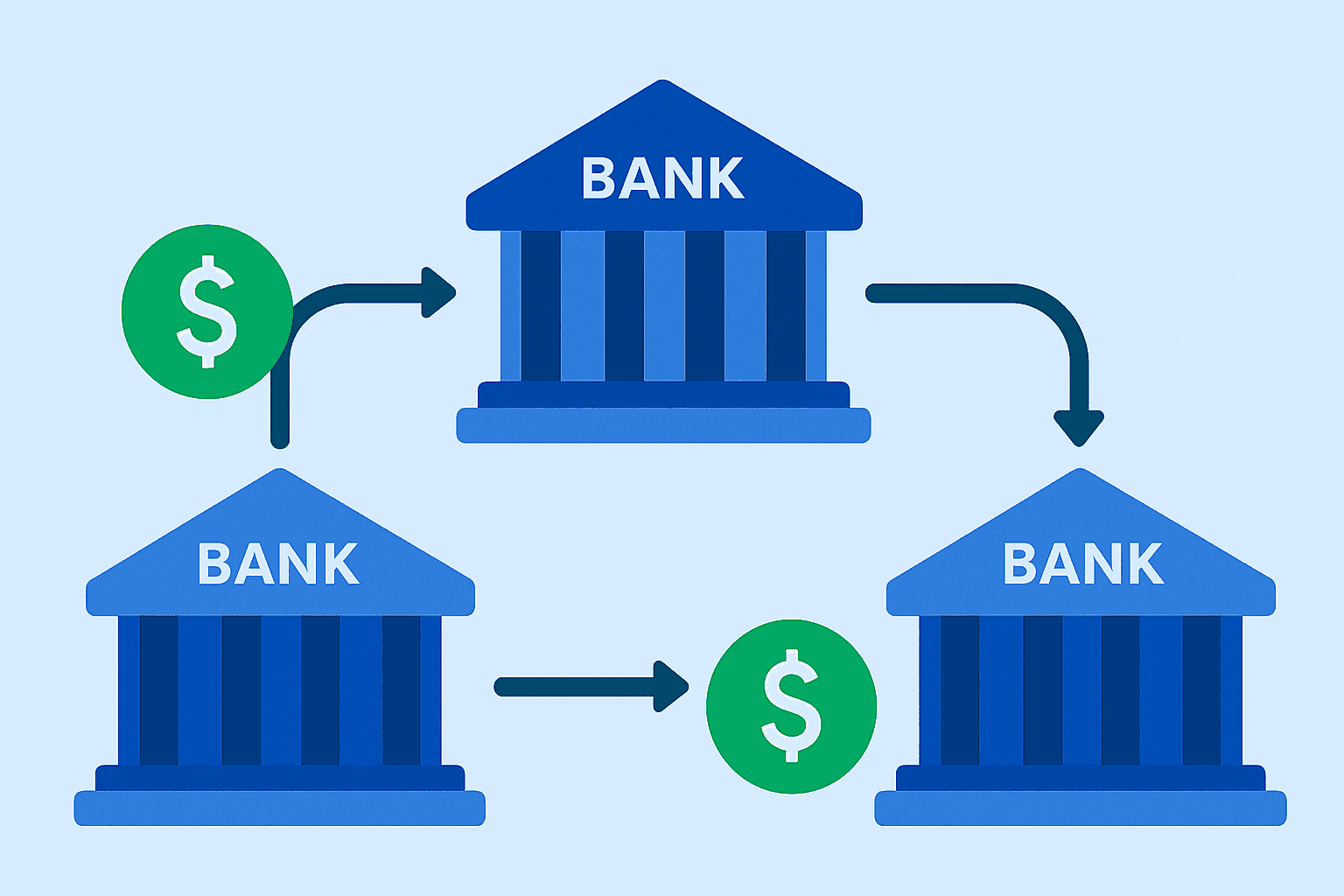
Here is how a Fedwire transfer moves, step by step:
How a Fedwire transfer settles in real time
The sender's bank receives the payment instruction and authenticates the request.
The sender's bank receives the payment instruction and authenticates the request.
The authenticated transfer is submitted to the Fedwire Funds Service.
The authenticated transfer is submitted to the Federal Reserve's Fedwire Funds Service.
The Federal Reserve routes the funds in real time to the beneficiary's bank.
The Federal Reserve routes the funds in real time to the recipient's bank.
Both the sender's and recipient's banks are notified of completion.
Both the sender's and recipient's banks receive notification of completion.
Funds settle immediately and the recipient can use them in real time.
Funds settle immediately, and the recipient can access them in real time.
- The sender's bank receives payment instructions and authenticates the request.
- The authenticated transfer is submitted to the Federal Reserve's Fedwire Funds Service.
- The Federal Reserve routes funds in real time to the recipient's (beneficiary) bank.
- Both sender and recipient banks receive notification of completion.
- Funds are immediately settled, and the recipient can access them in real time.
Fedwire is final and irrevocable. If your client sends to the wrong account, getting the money back is not guaranteed. So share your virtual account details in writing and double-check the routing number before anyone hits confirm.

What Is ACH and How Does It Work?
ACH (Automated Clearing House) is an electronic network governed by Nacha that moves money between US bank accounts. It's the system behind direct deposits, bill payments, and business-to-business transfers within the United States, and its defining feature is batch processing: the sender's bank collects payment instructions throughout the day, bundles them, and sends them out at scheduled intervals rather than settling each payment individually.
Here is how an ACH transfer moves, step by step:
How an ACH payment moves from sender to recipient
The sender gives payment instructions to their bank, the ODFI.
The sender initiates the payment, giving instructions to their bank, the Originating Depository Financial Institution (ODFI).
The ODFI groups ACH instructions into a batch for processing.
The ODFI collects ACH instructions and groups them into a batch for processing.
An ACH operator sorts the batch and routes it to the right banks.
An ACH operator (the Federal Reserve or The Clearing House) sorts the batch and routes each transaction to the right bank.
The RDFI receives the transaction and processes it for the account.
The Receiving Depository Financial Institution (RDFI) receives the transaction and processes it for the beneficiary's account.
Funds settle and are credited. Standard 1 to 2 days, Same Day ACH within the day.
After settlement, funds are credited to the account. Standard ACH takes 1 to 2 business days; Same Day ACH can settle within the same day.
- The sender initiates the payment: The sender provides payment instructions to their bank, known as the Originating Depository Financial Institution (ODFI).
- The bank groups the payment: The ODFI collects ACH payment instructions and groups them into a batch for processing.
- The ACH operator processes the batch: The batch is sent to an ACH operator, either the Federal Reserve or The Clearing House (TCH), which sorts the transactions and routes them to the appropriate receiving banks.
- The recipient's bank receives the payment: The Receiving Depository Financial Institution (RDFI) receives the transaction and processes it for the beneficiary's account.
- The funds are settled and credited: After settlement, the recipient's bank credits the funds to the beneficiary's account. Standard ACH typically takes 1–2 business days, while Same Day ACH can settle within the same business day.
- Same-day ACH: Same Day ACH is available for eligible transactions and has become increasingly common. Nacha reported 1.4 billion Same Day ACH payments worth $3.9 trillion in 2025, up 16.7% and 21.4%, respectively, from 2024.
- Same-day limit: As of 2026, the Same Day ACH per-transaction limit is $1,000,000, up from $100,000 in March 2024. This makes it suitable for some high-value B2B payments that might previously have required a wire.
- Cost: ACH transfers generally cost less than Fedwire. A typical ACH transfer may cost around $0.20 to $1.50, compared with roughly $25 to $35 for Fedwire.
- Transaction types: ACH supports two main transaction types: ACH credits, where the sender pushes money to the recipient, and ACH debits, where the recipient initiates a pull from the sender's account, such as an autopay.
- Reach: ACH is a domestic US payment system and is not designed to send payments directly to Indian bank accounts.

Fedwire vs ACH: Key Differences
The key differences between Fedwire and ACH span processing method, speed, cost, reversibility, and international reach, and each of these differences has a direct impact on when your USD payment from a US client actually lands in your account.
| Feature | Fedwire | ACH | What It Means for Indian Receivers |
|---|---|---|---|
| Processing method | Individual, real-time | Batch, scheduled intervals | Fedwire = predictable instant credit on the US side; ACH = payment may sit in a queue |
| Settlement speed | Minutes (during operating hours) | 1–2 business days (same-day available) | A ₹5L invoice sent via Fedwire on Friday clears that day; via ACH it may wait until Monday or Tuesday |
| Cost to sender | $25–$35 (bank fee) | $0.20–$1.50 | ACH is cheaper for your client — but it cannot reach India directly |
| Cost to recipient | Up to $20 (recipient bank fee) | Free to nominal | Fedwire charges both sides; ACH is typically free for the recipient |
| Reversibility | Irrevocable once settled | Reversible within specific timeframes | Fedwire errors cannot be undone; ACH errors can be disputed |
| Geographic reach | US domestic only | US domestic only | Neither reaches Indian bank accounts directly — both require a virtual US account or SWIFT leg |
| Best for | High-value, urgent, one-time payments | Recurring, lower-value, payroll-type payments | Not specified |
| Security | Real-time Federal Reserve oversight | Nacha authentication protocols | Both are secure; Fedwire's irrevocability means errors are costlier |
- Fedwire is operated by the Federal Reserve; ACH is governed by Nacha, two separate institutions with different mandates and settlement structures.
- Fedwire has a technical transaction ceiling of $9,999,999,999.99 per transaction; ACH is typically used for lower-value transactions, with same-day ACH now supporting up to $1,000,000 per transaction.
- ACH operates 24/7, though settlement times vary; Fedwire has fixed operating windows, Monday to Friday.
- Both are US-domestic systems: neither ACH nor Fedwire has direct cross-border capability to Indian bank accounts.
How Do Fedwire and ACH Affect Payment Settlement in India?
How Fedwire and ACH affect payment settlement in India depends on which US rail your client uses. Fedwire speeds up the arrival of funds at your virtual US account, while ACH is slower but cheaper, and both ultimately reach your Indian bank account via a SWIFT conversion leg.
How Fedwire Impacts Indian Settlements
- Fedwire is a real-time gross settlement (RTGS) system, so US payments settled via Fedwire clear instantly on the US leg, meaning funds arrive at the intermediary or partner virtual US account without delay.
- It's used for high-value, urgent export or corporate payments where same-day finality is required.
- Effect on Indian beneficiary: funds arrive faster at the virtual US account, speeding up the subsequent conversion and payout to the recipient’s Indian bank account in INR.
How ACH Impacts Indian Settlements
- ACH operates on deferred batch clearing. Standard ACH takes 1 to 3 business days to settle; same-day ACH is available at a premium.
- It's preferred for low-value, recurring payouts, such as marketplace disbursements, freelance invoices, and wages from US clients.
- Effect on Indian beneficiary: ACH is a lower-cost alternative that maximises the net INR value for smaller amounts by avoiding SWIFT intermediary fees, but it introduces a settlement delay compared to wire options.
- Practical example: a ₹5L invoice sent via your US client's Fedwire on a Friday clears the US leg that day; the same invoice sent via standard ACH may not settle until the following Monday or Tuesday, a meaningful difference when you're managing cash flow or a shipment deadline.
Is Wire and Fedwire the Same?
No, wire transfer and Fedwire are not the same thing. ‘Wire transfer’ is a broad, generic term for any electronic fund transfer between banks, while Fedwire is a specific, high-security real-time gross settlement network operated by the US Federal Reserve that banks use to settle those transfers instantly.
- Wire transfer is the umbrella category. Fedwire is one specific rail under that umbrella, used only for domestic USD transactions in the United States.
- Other networks that also fall under the "wire transfer" umbrella include SWIFT, for international transfers, and CHIPS (Clearing House Interbank Payments System), another large-value US system.
| Feature | Wire Transfer (Generic) | Fedwire (Specific Network) |
|---|---|---|
| What it is | A general payment method / category | The backend infrastructure / rail |
| Geographic scope | Domestic or international | Strictly domestic (United States) |
| Currency | Multi-currency | USD only |
| Settlement speed | Minutes to days (depends on network) | Instant and immediate (real-time) |
| Finality | Varies by network rules | Immediate, absolute, and irrevocable |
| Operator | Private clearing houses or various networks | The US Federal Reserve |
| Primary networks used | SWIFT, CHIPS, Fedwire | Fedwire Funds Service |
| Typical use case | Buying a house; sending international payment | Interbank settlements; high-value corporate transfers |
- When an Indian exporter’s US client says "I’ll send you a wire," they likely mean a SWIFT wire, not necessarily a Fedwire. Fedwire settles the US domestic leg; SWIFT carries the cross-border message to the Indian bank.
- Fedwire is irrevocable and final once settled; generic wire transfers using SWIFT may have limited dispute mechanisms but are also difficult to reverse.
Should Indian Exporters Request ACH or Fedwire Payments From US Clients?
Indian exporters should generally prefer ACH payments over Fedwire for routine, lower-value invoices, provided they use a virtual US bank account through a cross-border platform, since ACH minimises the client’s transaction costs. Fedwire should be reserved for high-urgency, high-value B2B settlements where same-day finality is critical.
- Critical structural point: neither ACH nor Fedwire can target a native Indian bank account directly, since both are domestic US rails. To receive payments via either method, an Indian exporter must use a cross-border platform that provisions a virtual US bank account number (VBAN) under their business name. The US client pays domestically, and the platform converts and remits funds to the Indian bank account.
- How a VBAN works: it functions like a regular US bank account, with a routing number and account number, but has no physical existence and cannot store a balance. It's a routing point that funnels incoming US funds to the Indian account.
Decision Framework: Three Scenarios for Indian Exporters
- Virtual USD account (like Skydo's) eliminates the complexity: regardless of whether your client uses ACH or Fedwire, you share your virtual USD account details. The US rail choice becomes your client's problem. You simply wait for the credit, get your FIRA/FIRC auto-generated, and close your EDPMS/eBRC obligations without chasing your bank RM.
- Fee and forex consideration: traditional SWIFT wires through Indian banks can drain exporter earnings via intermediary bank cuts and poor forex spreads. Using a virtual account with a transparent flat-fee platform bypasses unnecessary intermediary costs and locks in live exchange rates.
- Regulatory compliance point: make sure your chosen platform automatically tags inward remittances with correct purpose codes and issues an electronic Foreign Inward Remittance Advice (eFIRA/FIRC) to close out your EDPMS obligations.
- The choice of ACH vs Fedwire belongs to the US-based payer or their bank, not the Indian recipient. Indian exporters can express a preference, but ultimately the payer’s bank decides which domestic US rail to use.
How Does Skydo Simplify Receiving Payments from the US?
Regardless of whether your US client initiates via ACH or Fedwire, the payment ultimately reaches your Indian account as a Foreign inward remittance, and that is where Skydo steps in to make receipt, compliance, and settlement seamless.
- Skydo provides a free USD virtual account (VBAN) that receives Fedwire-originated SWIFT wires and ACH-sourced transfers from US clients, with no bank RM involvement, no paperwork at setup, and the account ready in 5 minutes.
- Skydo also offers free virtual accounts in EUR, GBP, SGD, AUD, and CAD, so exporters working with clients across multiple geographies get one platform for all inward remittances.
- Auto-generated FIRA certificates arrive for every transaction, so there's no need to chase your bank relationship manager after each inward remittance. Every USD payment received through Skydo comes with a FIRA automatically.
Which banks use Fedwire?
Banks, credit unions, and eligible financial institutions that hold an account with the Federal Reserve can access Fedwire, and this includes virtually all major US commercial banks. Businesses don’t access Fedwire directly; they instruct their bank to initiate a Fedwire transfer on their behalf.
Can Indian freelancers or exporters choose to receive via ACH instead of Fedwire?
Are SWIFT and Fedwire the same thing?
Which is better for paying Indian vendors, ACH or wire transfer?
What happens to my payment on the Indian side after my client sends via Fedwire or ACH?
Can ACH transfers be reversed? What about Fedwire?
What is same-day ACH and does it change anything for Indian exporters?
What is the difference between ACH, Fedwire, and SWIFT?