What Are Cross-Border Payments?

You've just finished a project for a client in the US. Invoice sent, work delivered. Now you're waiting for the payment to hit your account. But instead of a quick transfer, you're dealing with currency conversion, multiple bank fees, and a five-day wait. Welcome to cross-border payments. And you're not alone; cross-border transactions form a massive global market, valued at over $194 trillion in 2024 and projected to exceed $290 trillion by 2030. However, each payment comes with complexities that extend far beyond a simple bank transfer.
What are cross-border payments? At its simplest, a cross-border payment happens when money moves between countries. For businesses, these aren't simple one-click transactions. B2B cross-border payments involve matching invoices, contracts with specific payment terms, compliance documentation for tax authorities, and careful reconciliation for your accounting team. When you receive payment from an international client, you're not just getting paid; you're managing a paper trail for GST filings, maintaining records for audits, and ensuring everything matches up for your CA (Chartered Accountant).
Cross-border transactions can vary across industries and scenarios. For example, a SaaS company might invoice its Australian client monthly. A digital marketing agency could collect a quarterly retainer from Singapore. An exporter receives payment for goods shipped to Germany. Each transaction crosses borders, requires currency conversion, and generates documentation at every step.
How a Cross-Border B2B Payment Moves Through Banks
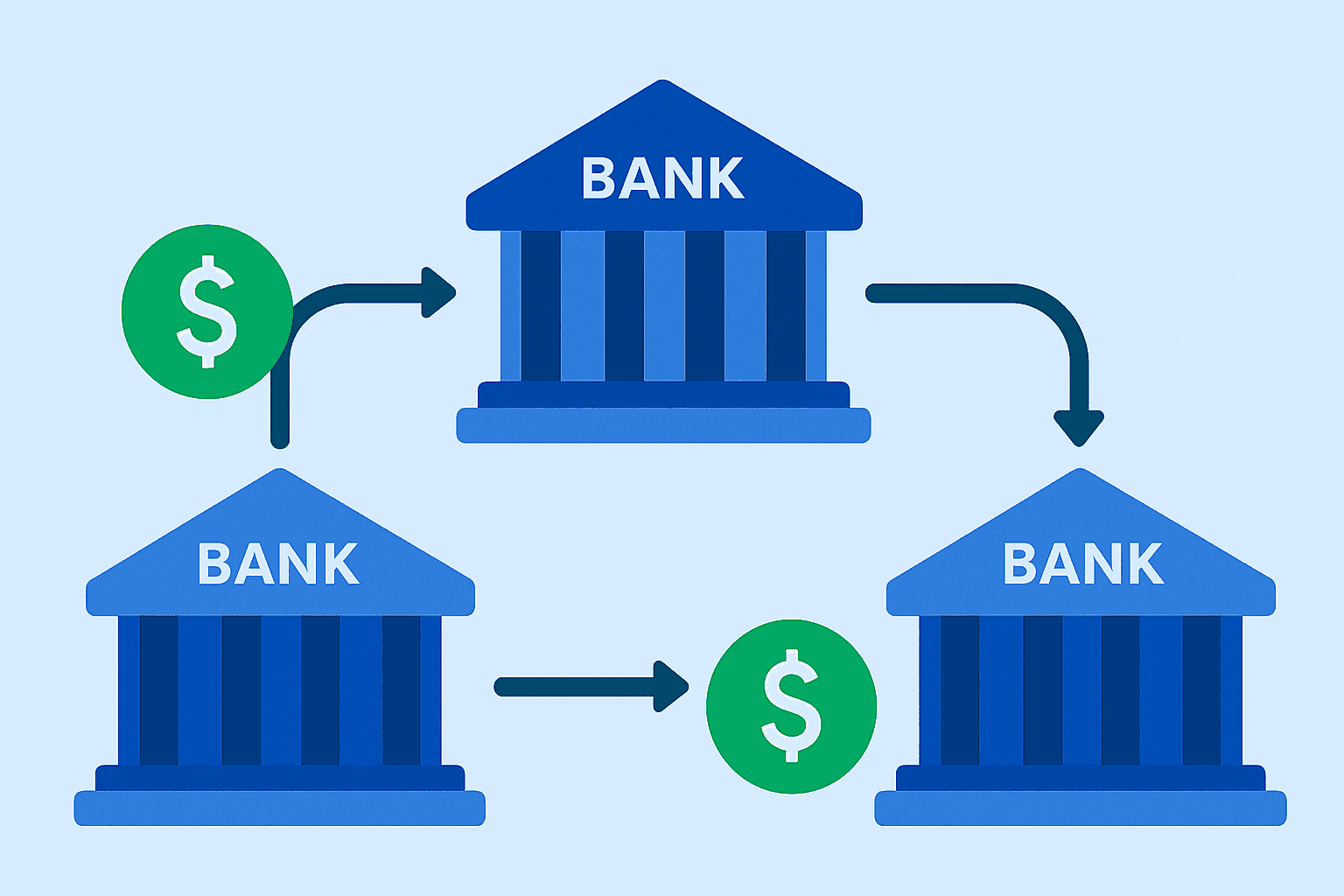
When you initiate an international payment to a vendor or client, your money doesn't travel directly from your account to theirs. Instead, it moves through several steps, each adding time and cost to the transaction:
- You initiate the payment: You instruct your bank to send the payment, either through online banking or at a branch. You'll need to provide the recipient’s full name, account number, bank name and address, the SWIFT/BIC code, and other details like IBAN (for European accounts) or routing number (for US accounts), the payment amount, and a payment reference or invoice number. Some banks also require the recipient's physical address and the payment's purpose for compliance screening.
- Payment instructions are sent: Your bank sends payment instructions via the SWIFT network, a secure messaging system banks use to communicate internationally. This SWIFT message includes the recipient’s account details, bank codes, payment amount, and any reference information you provided.
- Funds route through correspondent banks: Your bank might not have a direct relationship with the recipient’s bank, so it relies on intermediary correspondent banks to pass the payment along. These middlemen maintain nostro and vostro accounts with each other to facilitate transfers. (A nostro account is an account your bank holds in a foreign bank; a vostro account is an account a foreign bank holds with your bank.) The payment hops through these accounts until it gets closer to the destination bank.
- Currency conversion happens: At some point in the chain, your money gets converted from one currency to another. Where this conversion happens matters because it determines which bank’s exchange rate you get. One bank in the chain will perform the forex conversion and apply its exchange rate (which usually includes a markup).
- The receiving bank credits the beneficiary: Once the payment reaches the final bank, the recipient’s bank deposits the funds into their account. The beneficiary gets the money (often slightly less than sent, due to fees) and the bank generates a receipt or payment advice with the transaction details.
- Reconciliation begins: Finally, you or your accounts team will match the incoming payment to the original invoice. You verify that the payment reference is correct and note any fees deducted along the way. This step is crucial for accounting and ensures your records align with what was expected, especially if multiple invoices or clients are involved.
Each of these steps can introduce delays or costs. Now, let's explore the different ways businesses can send or receive cross-border payments and the expenses involved at each stage.
Common Methods for B2B Cross-Border Payments
Businesses have several options for sending and receiving international payments, each with trade-offs in speed, cost, and convenience. The main methods include traditional bank wires and newer fintech solutions:
1. SWIFT Wire Transfers (Traditional Bank Transfers)
This is the classic method for B2B cross-border payments. A SWIFT wire transfer moves money through the global banking network, so you can send money to virtually any country with an established banking system. The universal reach makes it reliable for large transactions or payments to countries where other options aren’t available.
However, the downsides are significant. Fees can pile up depending on how many correspondent banks handle your payment, and you often won’t know the exact cost until the transfer is complete. Settlement can take 3–5 business days or longer. There’s also the risk of short payments, where the recipient receives less than the invoiced amount because intermediary banks deducted fees along the way without warning.
2. Local Bank Transfers via Virtual Accounts
Some modern payment providers offer virtual local receiving accounts in various countries, even if your business is based elsewhere. Essentially, the provider gives you local bank account details (like an account number/routing for the US, or sort code/account for the UK) to share with your international clients. The client pays locally into that account, as if you were a domestic business in their country. For the client, it’s just a local transfer, no international wire fees or complex SWIFT forms.
For you, the provider then transfers the money to your home account (converting currency as needed). This method can avoid surprise intermediary fees because the initial transfer stays within the local banking system. The cost savings depend on the provider and currency corridor; not all providers support every country or currency combination. Still, using virtual local accounts often results in faster settlements (sometimes 1–2 days) and more predictable fees than a SWIFT wire.
3. Card or Online Payment for Invoices
In some cases, businesses accept credit card or online gateway payments for B2B invoices. This can work well when you need payment immediately or for smaller invoice amounts. The speed is unmatched – funds can arrive within minutes or hours, rather than days. However, for international transfers, while the fund transfer can be super quick, withdrawing it in your local currency might take more time.
Processing fees for card payments typically range from 2% to 5% of the transaction, plus some platforms and gateways levy an extra 1%–4% forex markup for cross-border card transactions. These fees add up quickly on larger invoices.
Cross-Border Payment Fees Explained (The Full Stack)
International payments come with multiple layers of fees that can eat into the amount you ultimately receive (or the amount your client has to pay). Understanding each cost in this fee stack will help you budget accurately and choose the most cost-effective payment method.
Bank-Route and Platform Fees
Whether you go through a traditional bank or an online platform, there are likely base fees for moving money internationally:
- Outgoing transfer fee (wire fee): If you're the sender, your bank will charge a fee to initiate the wire. In India, this might be around ₹1,000–₹2,000 for an outgoing SWIFT transfer. If you're the receiver, sometimes the sender passes this cost to you, depending on the fee instruction (explained below).
- Intermediary bank fees: As mentioned, any correspondent bank that handles the payment can deduct a fee. These "lifting fees" typically range from $10 to $25 each. The challenge is, you often don't know how many intermediaries will be involved. The payment could go through one intermediary or several, especially if it's an uncommon corridor.
- Receiving bank fee (inward remittance fee): The bank on the receiving end (in India, your bank) may charge a fee to process the incoming foreign payment. This is often ₹500 to ₹1,000 (or sometimes a flat $15–$30) per inward remittance, depending on the bank's policies.
- Platform or service fees: If you're using a payment gateway or fintech platform instead of a direct bank transfer, that service may charge its own fee. It could be a percentage or a flat fee per transaction. Sometimes this replaces some of the bank fees above (e.g., if a platform has its own banking network, you might avoid intermediary fees), but you need to compare the overall cost.
In summary, the bank-route fees can stack up from both ends (sender and receiver), whereas a platform fee might consolidate pricing but add its own cut. Always check both what the sender pays and what the receiver pays, because together they determine the true cost of transfer.
FX Costs (Currency Conversion Markups)
Currency conversion is often the biggest hidden expense in cross-border payments. Banks and many payment providers do not convert your money at the mid-market exchange rate (the real rate you see on Google or XE). Instead, they apply a markup or spread on the exchange rate as a form of commission.
Typically, banks might add a markup in the range of 2% to 4% above the mid-market rate for retail customers. Some fintech platforms might be lower (say 1%), but others can be even higher under certain circumstances. This markup is usually not disclosed explicitly; you won't see a line item saying "FX fee". It’s embedded in the rate you're quoted.
How to spot the FX cost: Suppose you need to receive £1,000 from a UK client. If the mid-market GBP/INR rate is 100, the true value of that payment is ₹100,000. If your bank credits you at a rate of 97 INR/GBP, you get ₹97,000. That implies a 3% markup (since 97 is 3% less than 100). In this example, ₹3,000 is effectively the fee taken as an exchange spread. The only way you realise this is by comparing the rate you got to the market rate at that time. Providers advertising "zero fees" often still make money by doing this – they waive transfer fees but give you an unfavourable exchange rate.
Over large transactions, the FX markup cost can dwarf the explicit fees. Always check the effective exchange rate. A quick method is to divide the final INR you got by the foreign currency amount to see what rate was used, then compare it to the market rate. The difference (in percentage) is what you paid for conversion.
Fee Instructions: OUR vs SHA vs BEN
When your international client sends you a SWIFT payment, their bank asks them to choose a fee instruction, OUR, SHA, or BEN. That single choice directly affects how much money actually lands in your Indian bank account.
Here’s what each option means for you as the receiver:
OUR – Best for You (Full Amount Received)
- With OUR, your client agrees to pay all the transfer fees – their bank’s fee, intermediary bank fees, and your bank’s inward fee (as far as the network allows).
- In practice, this means the payment is intended to reach you without any deductions. You should receive the full invoice amount (barring some rare cases where an intermediary still clips a fee).
- From your side, this is the option you always want.
SHA – Shared Fees (You Often Get Short-Paid)
- With SHA (shared), the client pays their own bank’s fee, but all other fees are taken out of the transfer amount.
- That means intermediary banks and your bank’s inward remittance fee are deducted from the money before it hits your account.
- The result: the amount you receive in your bank is usually less than the invoice value. You then have to either write off the difference or chase the client for the shortfall.
- This is the default at many banks, which is why Indian exporters and freelancers often see “randomly” short payments.
BEN – Worst for You (You Pay Everything)
- With BEN (beneficiary), your client pushes all fees onto you.
- Their bank fee, intermediary fees, and your inward remittance fee are all deducted from the payment amount on the way.
- You only receive whatever is left after everyone has taken their share. On a large payment, this can mean a meaningful loss.
- This option is rare in healthy B2B relationships, but some platforms or buyers may try to use it by default.
- From your point of view: BEN is almost always a bad deal unless you’ve priced it in very clearly.
Cross-Border Payment Cost Examples (Realistic Scenarios)
To put all these fees and FX costs into perspective, let's walk through a few realistic scenarios. These examples illustrate how much money might actually arrive versus what was sent, and why there's often a difference. (Exact fees will vary by banks and corridors, but we'll use representative figures.)
Example 1: $5,000 B2B invoice paid via SWIFT (SHA instruction) – Your U.S. client sends you $5,000 through a traditional wire, with fees set to SHA (shared). Suppose their bank charged a $30 wire fee, and two intermediary banks in the U.S. deducted $20 each. Your Indian bank also takes an inward fee of ₹1,000 (about $12). In addition, the currency conversion to INR had a 3% markup on the exchange rate. By the time the payment reaches your account, you might see roughly $4,900 worth in INR. In other words, you don't get the full $5,000 – a combination of wire fees and FX markup has reduced it. This is why invoices often arrive "short" when paid by international wire on SHA: each player along the chain quietly took a bit out.
Example 2: $5,000 paid via a local receiving account transfer – Now, imagine using a fintech platform that provides local account details. Your U.S. client pays $5,000 to a domestic U.S. account (no international wire needed on their end). The platform then converts and transfers the money to you in INR. Platforms like Skydo will charge a flat USD 29 in fees and offer live forex rate without any markup. There are no intermediary bank deductions because the transfer was routed intelligently through the platform's network. You receive very close to the full $5,000 value, minus that known fee. For example, you might get the equivalent of about $4,970 in INR. Settlement is faster (maybe 1-2 business days), and you know the costs upfront. In this scenario, both you and your client avoided the mystery fees and delays of the SWIFT network.
Example 3: $5,000 paid by card or online processor – Your client pays the $5,000 using a credit card or an online payment link. The processor (e.g., a payment gateway) charges 4% + a fixed fee, and also a 3% currency conversion fee. Let's say that totals roughly 7% (about $350) in fees. You end up with about $4,650 (in INR equivalent) delivered to your account. The upside is convenience; your client gets to pay in a couple of clicks with no additional setup, but on most platforms, you effectively pay a premium for that convenience. However, platforms like Skydo let you receive card payments from your US client at live forex rate without any markup.
Factors That Change How Much Money You Actually Receive
Not every international payment lands the same way in your account. These factors directly impact the final INR amount you receive and how long it takes to get there:
1. Currency Pair & Corridor
Some routes (USD → INR) are cheaper and more predictable than rare corridors. Popular corridors have better FX rates and fewer hidden deductions.
2. Number of Intermediary Banks
Every intermediary bank in the SWIFT chain deducts a fee before the money reaches you. More hops = smaller final payout.
3. Fee Instruction (OUR / SHA / BEN)
For SWIFT transfers:
- OUR → You receive the full amount (client pays all fees).
- SHA → You receive less (intermediary + inward fees are deducted).
- BEN → You receive the least (all fees come out of your payment).
This single setting often explains why payments arrive short.
4. Compliance Checks
If your payment is flagged for review (AML/sanctions/keywords), it can sit in manual screening for 1–3 days before being credited.
5. Cut-off Times & Holidays
If your client pays after a banking cut-off or during a holiday (in any country in the chain), your payment is pushed to the next working day.
6. Payment Network Used
SWIFT = slower, costly, unpredictable. Local rails / fintech networks = faster payouts, fewer deductions.
7. Double Currency Conversion
If the transfer route forces two conversions (e.g., USD → EUR → INR), the FX markup hits you twice and your final payout drops.
8. Size of Payment
Flat fees hurt small payments more; FX markups hurt large payments more. For receivers, this affects how much INR finally lands.
9. Frequency & Volume
Businesses that receive payments regularly often get better FX rates, lower fees, or platform discounts compared to one-off receivers.
10. Provider You Use
Banks vs modern platforms make the biggest difference:
- Banks → hidden FX, unpredictable deductions, slow credit.
- Modern platforms → clear rates, no intermediary fees, faster INR settlement.
Receiving International Payments in India: The Essential Paperwork
When foreign money lands in your Indian bank account, the payment isn’t “complete” until you have the required documents for tax, compliance, and audit purposes. Here are the only three things you absolutely need to track:
1. FIRA / FIRC: Proof of Inward Remittance
A Foreign Inward Remittance Advice/Certificate confirms that foreign currency was received and converted legally into INR. You’ll need it for:
- Income tax filings
- Audit trails
- Proof that the money came via authorised banking channels
Banks may issue FIRAs automatically or only on request. Always collect it immediately so you don’t struggle with backdated requests later.
2. eBRC: Bank Realisation Certificate (For Exporters)
If you export goods (and for some categories of software), you need an Electronic bank realisation certificate. It is:
- Mandatory for closing export files with customs
- Required for DGFT compliance and export benefits
- Proof that export proceeds were actually received in India
3. Maintain Documentation for Audits
For every international payment, keep:
- Invoice
- SWIFT/remittance advice from the client
- FIRA/FIRC
- Bank credit advice / statement entry
- eBRC (if applicable)
Best Way to Receive B2B Cross-Border Payments in India
After navigating through the ins and outs of cross-border payments, you might wonder: Is there a simpler way to get paid from international clients, without all the surprises and delays? For many Indian businesses, specialised cross-border payment platforms provide the answer.
Platforms like Skydo are designed specifically for Indian businesses receiving B2B international payments. Skydo’s cross-border payment platform, for example, provides predictable fees with no hidden intermediary deductions. You can see the live exchange rate and any markup transparently, side by side with the mid-market rate, before you commit to a transfer. This means you know exactly how much INR you'll get for a given foreign amount – no more guesswork or shortfall.
Speed is another benefit. Instead of waiting a week for a SWIFT wire to wend its way through global banks, modern platforms often credit your funds within a day or two. They achieve this by using local routes and smarter networks (as described earlier in the local receiving accounts method), effectively cutting out unnecessary middlemen.
Crucially, these platforms also simplify compliance and documentation. Exporters and service providers can get export-grade documentation without extra hassle, for instance, automatic generation of FIRA/firc as soon as the money arrives, and even eBRC integration for Amazon exports. By building these into their workflow, platforms save you from making multiple trips (or emails) to the bank for paperwork.
If your business regularly deals with international clients, using a modern cross-border payments solution can eliminate the unpredictability of fees and delays. You’ll know in advance what each transaction will cost, and you can ensure your overseas clients have an easy, local way to pay you (which can improve your chances of getting paid on time).
In summary, the best way to receive B2B cross-border payments, especially in India, is to leverage a platform that offers transparency, speed, and tailored support for local regulations. By doing so, you keep more of what you earn and get your money faster.
Explore Skydo and see how you can streamline your international payments, so you spend less time worrying about wire transfers and more time growing your business globally.
How can I track my cross border payments with Skydo?
Skydo provides real-time payment tracking through its platform. Once a transaction is initiated, you can monitor its progress and receive instant updates until the payment reaches your account.
Does Skydo offer support for multiple currencies?
How do exchange rates impact cross border payments?
What documents are required to receive cross border payments in India?