EDF Filing Guide: Changes for Service Exporters in 2026

Skydo now assists service exporters with EDF form generation
TL;DR
- What is an EDF? An Export Declaration Form (EDF) is a mandatory form that declares the value of your export to RBI. It creates a tracking entry in EDPMS (Export Data Processing and Monitoring System) that stays open until your payment arrives and is verified by your bank.
- What is changing with EDF filing from October 2026? From 1 October 2026, EDF filing applies to service and software exporters, including freelancers, agencies and SaaS companies, and SOFTEX is retired for software exports made on or after that date.
- How do you file an EDF? For goods exports, the EDF is auto-filed with your shipping bill on ICEGATE at major ports, while smaller non-EDI ports need it submitted separately through customs and your AD bank. From 1 October 2026, service exporters file one EDF a month with their AD bank (or STPI for software), within 30 days from the end of the invoice month, so the EDF for October 2026 invoices is due by 30 November 2026.
- What goes into filing an EDF? An EDF captures exporter details, buyer details, a description of the goods or services with the correct HS or SAC code, invoice details, shipping details and the expected payment mode. For services, PAN and a SAC code for each invoice are mandatory, GST and IEC are not, and the shipping fields are left blank.
What is the Export Declaration Form (EDF)?
The Export Declaration Form (EDF) is a mandatory document that records the value and details of goods or services you're exporting from India. Under FEMA regulations, it serves as an official declaration to RBI that an export has occurred and that payment is expected. Every exporter in India must file it, subject to the rules and exemptions in the regulation.
If the EDF is not filed correctly, the corresponding EDPMS entry may remain unresolved, which can lead to export compliance issues under FEMA regulations. For goods exporters, it can also delay eBRC generation. Service exporters get an eBRC too, which they generate on the DGFT portal by linking their payment (IRM) to invoices carrying the right SAC codes.
How Does EDF Work?
- For goods, EDF is automatically triggered when an exporter files a shipping bill on ICEGATE. For services and software, the exporter submits the EDF to their AD bank.
- This tracking entry is on RBI's EDPMS.
- That entry stays open until the exporter's payment comes in and the bank verifies it.
- The payment details and the details from EDF are required to obtain eBRC (electronic Bank Realization Certificate) from DGFT portal.
- The eBRC certifies that your export proceeds have been realised, and also helps the exporter claim benefits like RoDTEP refunds and duty drawbacks.
💡 QUICK INSIGHT
EDF is not the same as a shipping bill. The shipping bill is a customs document, while the EDF is RBI's exchange control document. At most ports, the EDF is auto-filed with the shipping bill.

EDF Form Template
- ✓ Instant Time Saver
- ✓ Avoid Costly Mistakes
- ✓ Get the Professional Edge
What's Changing With EDF From October 2026?
From 1 October 2026, service and software exporters must file an Export Declaration Form (EDF) with their AD bank. You file one EDF a month covering all your invoices, within 30 days from the end of the invoice month. SOFTEX is retired for software exports. The new rules were notified by RBI on January 13, 2026, under FEMA 23(R)/2026-RB.
1. Service Exporters Now File One EDF a Month
Agencies, consultancies, SaaS companies and other service businesses come under EDF for the first time. Individuals with transactions of a personal nature are not covered, as RBI clarified on 7 October 2026. You get 30 days from the end of the invoice month to file, so March invoices are due by April 30. You can club all your monthly invoices into one form.
If you export services other than software, you can also file earlier, on or before the date you receive payment. If you need more time, your AD bank can extend the deadline on a request with reasons.
2. SOFTEX Is Replaced for Software Exports
Software exports are now covered under the unified EDF framework alongside other service exports. STPI certification is no longer mandatory, and your AD bank can certify them. Software exporters stay on the strict 30-day deadline, with no payment-date option.
3. Every Service Payment Is Now Tracked in EDPMS
Authorised Dealers must update the EDF details in EDPMS within five working days of receiving the EDF. An Inward Remittance Message (IRM) is now generated for every service purpose code, so every service payment leaves a record that has to be matched.
4. More Time to Realise Payments, and Relief for Small Invoices
Export proceeds for services must be realised within 9 months from the invoice date, or 12 months if invoiced or settled in INR. RBI set these limits through a 22 September 2026 amendment, which replaced the 15 and 18 months in the January text, so older guides may show the wrong numbers. For any shipping bill or service invoice up to ₹10 lakh, your bank can close the EDPMS entry on your own declaration that payment was realised, or through a quarterly bulk declaration. The limit applies to each bill. Banks have not yet published how they will run this route, so check with yours.
5. New Rules for Banks
AD banks must publish their export policy and the main features of their SOP on their website (Regulation 19(4)). A bank cannot charge you a penalty for its own regulatory delay (Regulation 19(3)). For goods, exporters can now declare nil export value where goods go without consideration, such as certain free samples.
What Does This Mean for You?
- Amazon and e-commerce sellers: No major change. Your shipping bill filed through customs continues to serve as the EDF for goods exports.
- IT and software exporters: Software exports will move to the unified EDF framework from October 2026, replacing the separate SOFTEX-based reporting process.
- Freelancers, consultants and agencies: If you are an individual with transactions of a personal nature, RBI says you are not covered. If you invoice overseas clients as a business, under a firm name, a GSTIN or a proprietorship, prepare as though you are in scope until RBI’s FAQs settle it. Agencies and registered firms file one EDF a month.
- SaaS and digital service companies: Multiple invoices raised in a month can be consolidated into a single EDF, reducing repetitive reporting and simplifying compliance.
Skydo’s free EDF generator builds the form for you. The submission itself goes through your AD bank. Get to know more!
✅ PRO TIP
The filing format and channel (online or at the branch) will vary by bank. Every AD bank must publish its EDF policy and SOP on its website, so check your bank's page before October 2026.
What Did RBI Clarify on 7 October 2026?
On 7 October 2026, RBI said individuals do not need to report transactions of a personal nature under the new regulations, irrespective of the amount. RBI will publish FAQs to clear up the confusion. These are not out yet.
What RBI said on 7 October 2026
| Point | Detail |
|---|---|
| Individuals | Not covered for transactions of a personal nature, whatever the amount. |
| Examples given | Paying for an app, a TV channel or a newspaper. Earning from tutoring or small software work from abroad. |
| Who reports to RBI | Banks and authorised dealers report on the RBI platform. Exporters do not log in to RBI or EDPMS. |
| ₹10 lakh self-declaration | Available for bills up to ₹10 lakh. The limit applies to each bill. |
| FAQs | Promised shortly. Not published as of 12 October 2026. |
How to File the EDF: A Step-by-Step Guide
Service and software exporters file one EDF a month with their AD bank, covering every invoice raised that month, within 30 days from the end of the invoice month. Goods exporters at major ports file automatically through the shipping bill on ICEGATE, while non-EDI ports need a separate submission.
Services (From October 2026)
For service exporters, the process is expected to become more structured under the new FEMA 2026 framework. The regulation is final, but banks are still building their own SOPs, formats and submission channels.
Based on the current regulations, the process will broadly involve:
- maintaining records of export invoices raised during the month,
- preparing a consolidated EDF covering those invoices,
- and submitting the declaration to your AD bank within 30 days from the end of the invoice month.
The bank is then expected to update the export details in EDPMS and close the entry once payment is realized. Step by step, it looks like this:
Service export EDF process, from October 2026
- Raise your invoices as usual. Each invoice needs a number, date, currency, amount and your overseas client's details.
- Tag each service with its SAC code. SAC is the services version of an HSN code. It is mandatory on the EDF, and most exporters do not track it today.
- Compile the month's invoices into one EDF. Fill Part 1 (General Information) and Part 2B (Export Value of Services). Leave the goods fields blank.
- Sign the declaration. Sign as the exporter or authorised signatory.
- Submit it to your AD bank within 30 days from the end of the invoice month. Software exporters can also file through STPI, which forwards the authenticated EDF to the bank.
- Your bank enters it in EDPMS. Within 5 working days, this opens an export entry against your PAN.
- Receive payment. An IRM is recorded and matched to your entry. Once the full value is realised, the bank marks the entry off.
The Deadline Rule: 30 Days From the End of the Invoice Month
EDF filing: common situations
| Situation | What to do |
|---|---|
| Several payments against one invoice | One invoice is one row on the EDF, however many instalments arrive. |
| No invoices raised in a month | Nothing to declare. The obligation follows the invoice. |
| Need more time | Ask your AD bank for an extension with reasons, before the deadline. |
Five October invoices mean one EDF, due 30 November. If you need more time, ask your AD bank for an extension with reasons.
Services vs Software: When You Can File?
EDF filing: common situations
| Situation | What to do |
|---|---|
| Several payments against one invoice | One invoice is one row on the EDF, however many instalments arrive. |
| No invoices raised in a month | Nothing to declare. The obligation follows the invoice. |
| Need more time | Ask your AD bank for an extension with reasons, before the deadline. |
Which AD Bank Do You File With?
Banks are still finalising their formats, so expect the process to vary and settle over the coming months.
What varies by bank: questions to ask
| What varies by bank | Ask your bank |
|---|---|
| TemplateRBI's published form or their own | Which EDF template do you want us to use? |
| ChannelBranch, email or online portal | Do you accept submission by email or portal? |
| Supporting documents | What documents do you need with the EDF? |
| Sign-off and confirmation | How will you confirm you've received it? |
Skydo’s free EDF generator builds your monthly EDF, ready to submit to your bank.
Goods, Major Port (EDI)
This is the method most exporters use. The EDF is handled automatically when you file your shipping bill.
Start by registering your bank's AD code on ICEGATE. Then file your shipping bill on ICEGATE, the export declaration form is submitted automatically with it. Customs clears your shipment, and an EDPMS entry is created in the system.
Within 21 days, send your documents to the bank: commercial invoice, packing list, bill of lading, or airway bill. When payment arrives, the bank matches it to the EDPMS entry and closes it. Once that's done, you can apply for your eBRC on the DGFT portal.
Goods, Smaller Port (Non-EDI)
At non-EDI ports, EDF details may need to be submitted separately instead of being automatically linked through the shipping bill system.
Typically, exporters:
- submit the EDF and shipping documents to customs authorities at the port,
- provide export documents to their Authorised Dealer (AD) bank,
- and work with the bank to track payment realization and closure of the EDPMS entry.
What Information Goes Into the EDF?
The EDF captures your details (name, PAN, AD bank code), your overseas client's details, each invoice with its SAC or HS code and value, and the expected payment mode. Service exporters fill Part 1 and Part 2B of the form. Goods exporters also add shipping details such as port and shipping bill number.
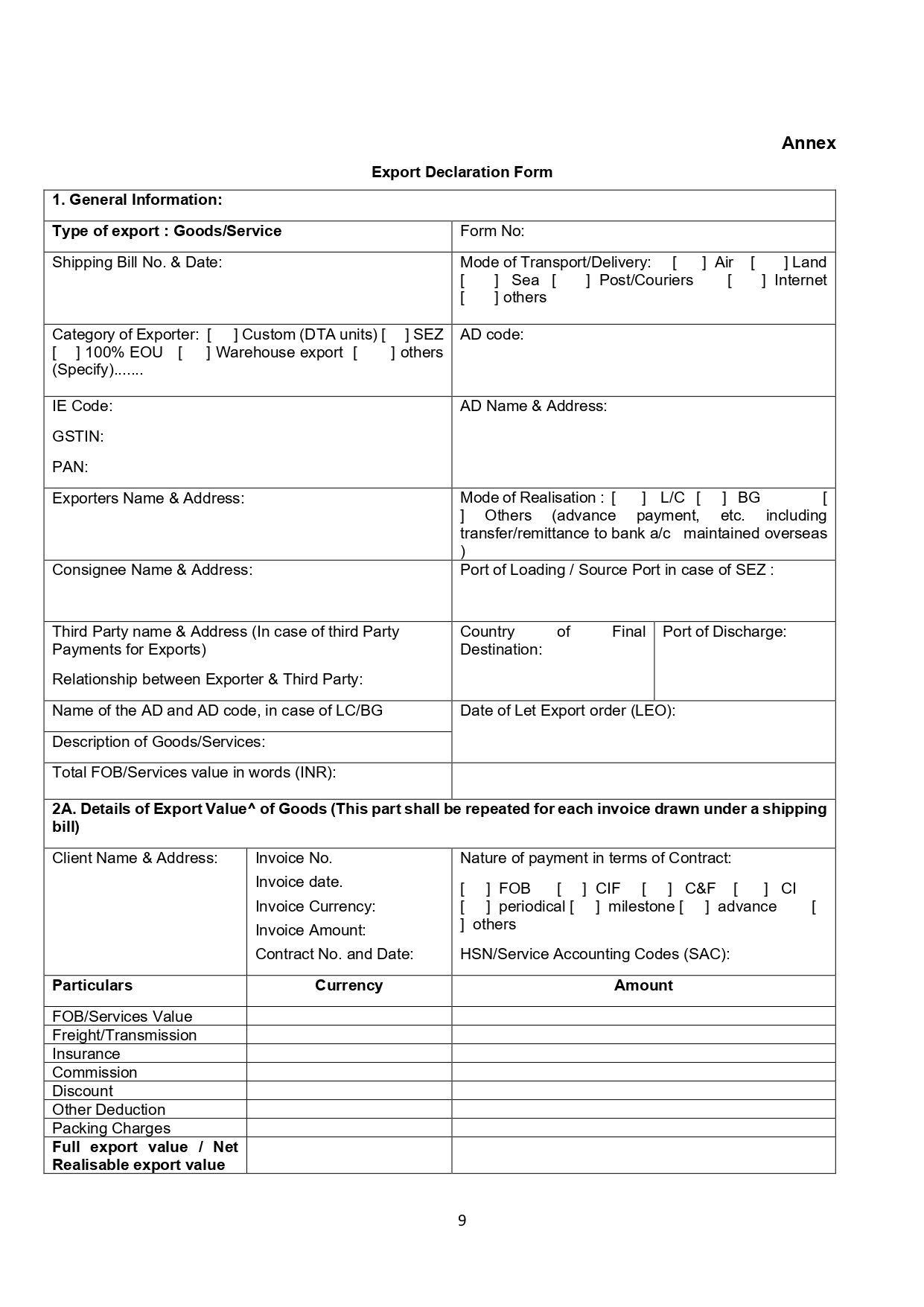
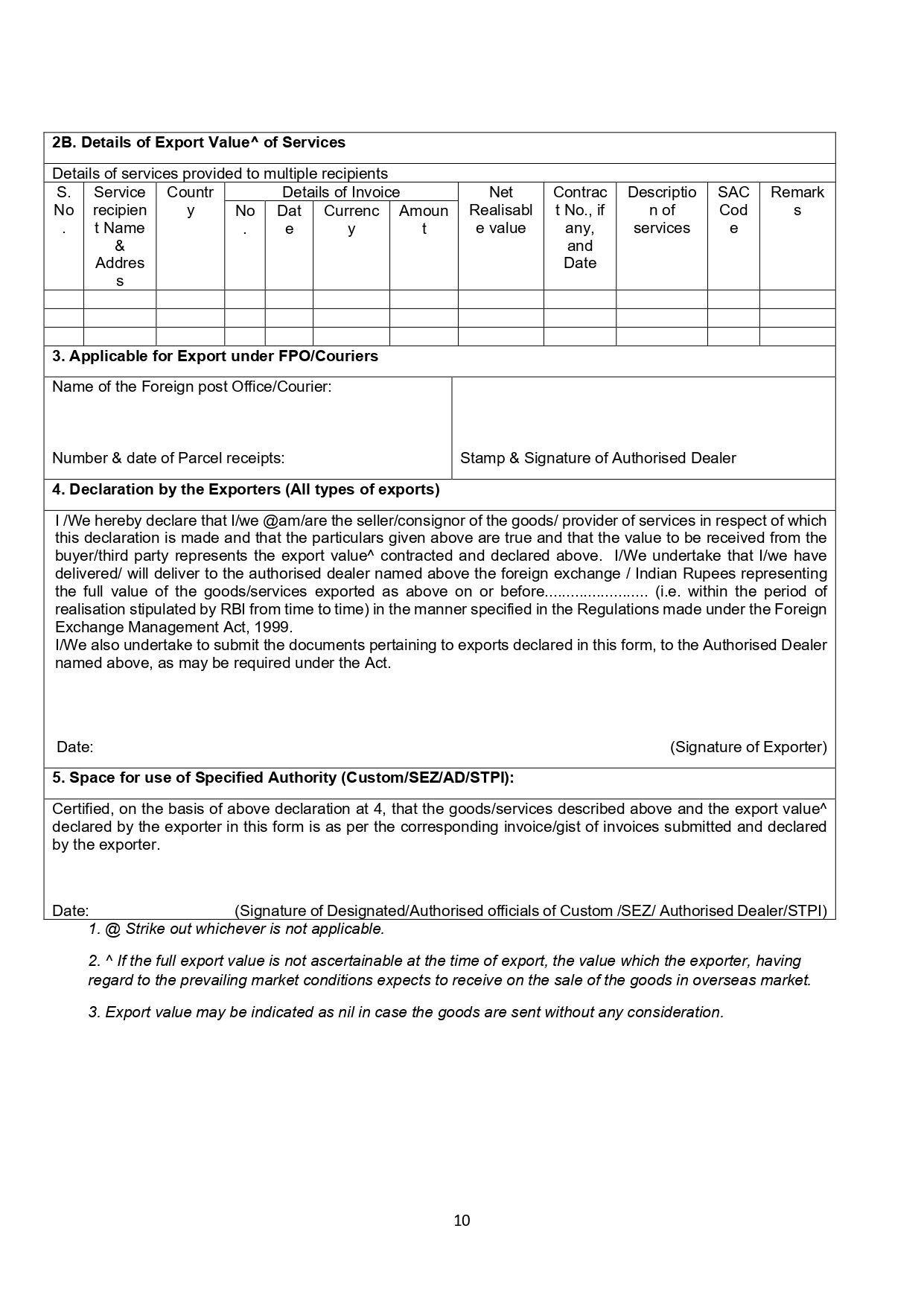
The EDF captures details about the exporter, buyer, shipment, and payment terms. You'll typically need:
- Exporter details: name, address, PAN, and AD code (plus IEC and GSTIN for goods exports)
- Buyer details: name, address, and country
- Export details: description of goods/services and the correct HS/SAC code
- Invoice details: invoice number, currency, and export value
- Shipping details (goods only): port, destination country, transport mode, and shipping bill details
- Payment details: expected mode of realization, such as advance payment, LC, or open account
The information in the EDF must match your invoice and shipping documents to avoid processing or compliance issues. Checkout the Export Declaration Form (EDF) Sample at the end of this RBI notification.
SAC Codes and Purpose Codes for Your EDF
The SAC (Services Accounting Code) is the services version of an HSN code: a six-digit code that classifies what you sold. It is mandatory in Part 2B, and it is the field most exporters don’t have ready.
Common SAC codes for service exporters
| SAC | Covers | Typical exporter |
|---|---|---|
| 998313 | IT consulting and support services | IT consultancies, managed services |
| 998314 | IT design and development services | Dev shops, product engineering, SaaS build |
| 998315 | Hosting and IT infrastructure provisioning | Hosting, cloud and infra providers |
| 998361 | Advertising services | Agencies, performance marketing |
| 998371 | Market research and public opinion polling | Research firms, insight consultancies |
| 998399 | Other professional, technical and business services | Design, consulting and anything not listed above |
These are common examples. The right SAC depends on what you actually sell, so confirm it with your CA and use the same code in your GST returns and your EDF. Your SAC code should also be consistent with the purpose code on your payment.
Filling the EDF as a Service Exporter
The form above is the goods version. Service exporters fill Part 1 and Part 2B of the same form, and leave the goods fields blank.
Part 1: General Information
| Field | What to enter as a service exporter |
|---|---|
| Type of export | Tick Service. This decides which part you fill next. |
| PAN | Mandatory. Your EDPMS entry sits against this PAN. |
| GSTIN and IEC | On the form, but not mandatory for a services EDF. |
| AD code and AD name | The bank where your payment is finally settled. |
| Mode of delivery | Internet is a valid option and covers most service exports. |
| Shipping bill, LEO date, port fields | Goods only. Leave blank. |
Part 2B: Details of Export Value of Services
Part 2B takes one row per invoice, so a single EDF can carry every invoice you raised in the month.
| Field | What it means |
|---|---|
| SAC code | The services version of HSN. Mandatory, and the field most exporters don't have ready. |
| Description of services | Plain-language description that matches your SAC code. |
| Contract number and date | Optional. Leave blank if there's no separate contract. |
| Net Realisable Value | What you actually expect to receive after deductions. Not always the gross invoice amount. |
Section 4 is your declaration and signature. Section 5 is filled by your AD bank, or STPI for software.
Checkout the Export Declaration Form (EDF) Sample at the end of this RBI notification
SOFTEX to EDF: What Changes for Software Exporters
SOFTEX is retired. For software exports made on or after 1 October 2026, you file one EDF a month instead, and STPI certification is no longer mandatory. The cutover follows the export date, so a software export made in September 2026 and filed in October is still a SOFTEX.
| Exports up to 30 Sept 2026 | Exports from 1 Oct 2026 | |
|---|---|---|
| Form | SOFTEX | EDF |
| Frequency | Per transaction | One consolidated EDF per month |
| Certification | STPI certification mandatory | STPI not mandatory; AD bank can certify |
| Regime | Separate from other services | Same as all other services |
- No payment-date flexibility: Other service exporters can file on or before receiving payment. Software exporters stay on the strict 30-days-from-month-end clock.
- Filing through STPI: STPI forwards the authenticated EDF to your AD bank.
Note: You May Be a Software Exporter. The regulation defines software broadly: any computer programme, database, drawing, design, audio or video signals, or information on any non-physical medium. A design studio, video editor or architect sending drawings abroad can count as a software exporter.
What to Do Before Your First EDF Is Due?
Your first services EDF is likely due on 30 November 2026, for October invoices. Before then, review the EDF format, find the SAC code for each service, organise your client data, check your AD bank's published EDF SOP, and speak to your CA. SAC classification takes time and banks are still finalising their SOPs, so start now.
| # | Action | Why |
|---|---|---|
| 1 | Review the EDF format, especially Part 2B | Know what each column asks for |
| 2 | Find the SAC code for each service you sell | Mandatory, and most exporters don't have it |
| 3 | Organise client data: names, addresses, countries, contract references | Avoid a month-end scramble |
| 4 | Check your AD bank's published EDF SOP | Format, channel and documents vary by bank |
| 5 | Speak to your CA | Especially on SAC classification and how EDF fits with your other filings |
Using more than one payment provider? Each can only give you records for payments it handled, so collect data from all of them.
What Are Some Common EDF Mistakes and How to Fix Them?
The most common EDF mistakes are counting the deadline from the invoice date instead of month end, missing SAC or HS codes, filing with the wrong AD bank, and invoice values that don't match the EDF. Most are fixed by keeping codes, invoices and payment records in one place before month end.
Service Exporter Mistakes
| Mistake | Fix |
|---|---|
| Counting 30 days from the invoice date | Count from the end of the invoice month. A 22 October invoice is due 30 November. |
| Filing one EDF per invoice | Club all of a month's invoices into one EDF. |
| Missing SAC codes | Map each service to its SAC code in advance, with your CA. |
| Assuming the bank on your FIRA is your AD bank | File with the bank where your payment finally settles. |
| Treating FIRA as the EDF | FIRA proves money came in. The EDF declares the export. |
| Skipping the EDF because payment already arrived | Receiving payment and declaring the export are separate steps. |
| Assuming you're "services" when you're "software" | Designs, drawings, audio and video files count as software, with a stricter deadline. |
Using the Wrong HS Code
If the HS code doesn't match the product being exported, customs can flag the shipment or raise valuation and duty queries. Always verify the latest tariff classification before filing.
Invoice and EDF Values Don't Match
Mismatch between invoice values and EDF details can lead to bank queries, processing delays, or rejection of export documents. Double-check currency, invoice amount, and export value before submission.
AD Code Not Registered on ICEGATE
If your bank's AD code is not registered on ICEGATE, shipping bill processing can get blocked. First-time exporters should confirm this setup with their bank in advance.
Delays in Document Submission
Late submission of export documents can leave EDPMS entries unresolved for longer than necessary. Keeping documentation organized and submitting it promptly helps avoid follow-ups and compliance issues.
Payment Received, but EDPMS Still Open
Sometimes payments are received, but the corresponding EDPMS entry is not updated or closed. Maintain a tracker with invoice numbers, shipping bill details, payment dates, and bank status updates to monitor closures properly.
Service Exporters Not Preparing for EDF Compliance
From October 2026, service exporters will come under the EDF reporting framework. Freelancers, agencies, SaaS companies, and other service exporters should start understanding their bank's expected process well before the regulations take effect.
Why Is EDF Required?
The EDF is required because the RBI must track all exports and verify that foreign exchange earnings are repatriated to India. This is mandated under FEMA (Foreign Exchange Management Act), which regulates cross-border transactions. Without the EDF, RBI has no way to monitor whether export proceeds were received or repatriated as required by law.
- EDF confirms that the shipment complies with customs rules, export controls, and foreign trade requirements.
- It provides essential export data used for trade monitoring, policy planning, and incentive schemes.
- It acts as proof of export for banks, DGFT compliance, GST filings, payment reconciliation, and incentive claims.
How EDF and EDPMS Work Together
| Stage | What happens |
|---|---|
| 1. EDF goes in | Your AD bank enters the EDF into EDPMS within 5 working days, opening an export entry against your PAN. |
| 2. IRM goes in | When payment lands, an IRM is recorded. IRMs are now generated for every service purpose code. |
| 3. Entry marked off | The bank matches the payment to the entry and marks it off once the full value is realised. |
Realisation Timelines and Small-Invoice Relief
- Services: Realise proceeds within 9 months from the invoice date, or 12 months if invoiced or settled in INR..
- Invoices up to ₹10 lakh: For goods or services, your bank can close the EDPMS entry on your declaration that payment was realised, or through a quarterly bulk declaration. The limit applies to each bill, so annual earnings above ₹10 lakh don’t rule you out. Banks have not yet published how they will run this route, so check with yours.
What Happens If You Don't File your EDF?
The EDPMS entry stays open against your PAN. An IRM is now generated for every service purpose code, so a payment with no matching EDF shows up as a gap.
What happens if the EDF is not filed
| Step | What happens |
|---|---|
1EDF not filed | Deadline passes |
2Payment arrives | IRM generated |
3Nothing to match | No export entry exists |
4Entry stays open | Against your PAN |
5Bank follows up | Until regularised |
Under Regulation 18(1)(f), your AD bank must monitor open entries and follow up with you for documents until they are closed. Banks may also stop inward SWIFT foreign currency payments to your account if your EDF isn’t filed on time. Payments through aggregators like Skydo settle over domestic rails, so they can’t be selectively stopped today. You still need to file your EDF.
Who Needs to File an EDF?
From 1 October 2026, every business exporting goods, services or software from India needs to file an EDF, subject to the regulation’s rules and exemptions. On 7 October 2026, RBI clarified that individuals are not covered for transactions of a personal nature, and FAQs will define the exact scope.
| Exporter type | File now? | After Oct 2026 | How they file |
|---|---|---|---|
| Goods exporters: physical products shipped abroad | EDF | EDF | EDF is associated with the export declaration for goods. The filing process depends on the port and applicable customs procedures. |
| Software / IT exporters: IT, ITeS and SaaS companies | SOFTEX, where applicable | EDF, subject to applicable rules | Software exporters should check the applicable transition from SOFTEX to EDF, including the filing process and reporting frequency under the new framework. |
| Designers, video editors and architects: designs, drawings, audio and video files | Depends on the service and transaction | Depends on the applicable rules | Classification depends on the nature of the export and the applicable reporting requirements. Do not assume that every digital file is automatically classified as software. |
| Agencies & service firms: marketing, content, legal and consulting | Generally no EDF under the existing process for ordinary service receipts | EDF, if covered by the new requirements | Service firms should confirm whether their transactions fall within the new EDF framework and follow the applicable filing deadlines and procedures. |
| Individual freelancers & creators | Depends on transaction type | Depends on the applicable rules | The treatment of individuals receiving overseas payments may depend on the nature of the transaction and whether the activity is conducted as a business. Confirm the applicable requirements before filing. |
| E-commerce / Amazon sellers: courier and marketplace shipments | EDF and shipping documentation, as applicable | EDF, subject to applicable procedures | Export declarations and related EDPMS entries must be handled through the applicable shipping or courier process. Exporters should ensure that outstanding entries are reconciled and closed with their AD bank. |
Goods exporters: Yes. If you're shipping physical products out of India, you need to file an export declaration form.
Software exporters (IT/ITeS): Right now, software exporters file a different form called SOFTEX through STPI or SEZ authorities. For software exports made on or after 1 October 2026, SOFTEX is retired and everyone will need to file the EDF instead.
Service exporters (non-software): Freelancers, consultants, and agencies providing services such as marketing, legal, accounting, business consulting, or financial advisory to clients outside India are generally classified as non-software service exporters. Under the FEMA 2026 regulations, service businesses come under the EDF framework from October 2026. Individuals with personal-nature transactions are not covered, per RBI’s 7 October clarification
Designers and creative exporters: The regulation defines software broadly, covering databases, drawings, designs, and audio or video files. If you export these, you're likely treated as a software exporter, with no option to file on the payment date.
Amazon and e-commerce sellers: Every commercial courier shipment you send abroad automatically creates an EDPMS entry. Many sellers have hundreds of open entries sitting in the system and don't even know it. Each one needs to be matched with a payment and closed.
EDF vs SOFTEX vs SDF vs FIRA vs eBRC: Quick Comparison
The EDF declares an export and its value, the FIRA proves an inward payment was received, and the eBRC certifies that export proceeds were realised. SOFTEX was the separate software declaration, now retired for exports from 1 October 2026, and SDF was the goods declaration filed through EDI customs ports, now integrated into the EDF.
Historically, different forms were used for goods, software, and electronic customs filings. For example, SDF (Statutory Declaration Form) was the declaration mechanism used for goods exports through EDI-enabled customs ports, while SOFTEX was used for software exports. Under the FEMA 2026 regulations, these processes are being consolidated under a unified EDF framework.
| Form | Used for | When it was filed | Position under FEMA 2026 |
|---|---|---|---|
| EDF | Goods exports (primarily non-EDI exports) | At the time of export | Continues under the unified EDF framework |
| SDF | Goods exports through EDI customs ports | Automatically through shipping bill filing | Integrated into the EDF framework |
| SOFTEX | Software and IT service exports | After export, within prescribed timelines | Replaced by EDF reporting |
| Unified EDF (2026) | Goods, software, and service exports | Goods: at export. Services: within 30 days from month-end of invoicing | Common export declaration framework across export categories |
| FIRA | Proof that an inward remittance was received | When the payment lands | Continues; does not replace the EDF |
| eBRC | Certifies that export proceeds were realised | After realisation | Continues; comes after the EDF |
How Skydo Helps With EDF Compliance
Once the EDF process is completed, the next step is ensuring export payments are received, documented properly, and matched against the correct export entries for closure. That's where most exporters end up spending time on manual follow-ups and reconciliation.
Skydo helps simplify that part of the workflow. With Skydo:
- you get dedicated virtual accounts to collect international payments,
- every inward remittance comes with instant FIRA,
- payment records stay structured and eBRC closure is processed by Skydo,
- Skydo’s free EDF generator builds your monthly EDF, ready to submit to your bank.
If you also receive payments through other providers, you'll need their records too. Skydo can supply data only for payments received through Skydo.
Want to see what hassle-free export compliance looks like? Explore Skydo.

Get international bank accounts in 5 mins

Save as much as ₹10 lakh annually with Zero FX Margin

Real time payment tracking and instant FIRA
Get international bank accounts in 5 mins
Save as much as ₹10 lakh annually with Zero FX Margin
Real time payment tracking and instant FIRA
Frequently asked questions
The EDF is a mandatory form you submit to declare the value of goods or services you're exporting from India. It's required under FEMA and creates a tracking entry in RBI's EDPMS system.
About the author

Head of Operations
Leads Payment Operations and Experience at Skydo, building seamless, automated cross-border systems. Previously at McKinsey, P&G, Delhivery, and ShopDeck, with expertise in operations and process optimization.

Verified by
CA Abhilove ShardaLatest blog posts
View all posts
AD Code Transfer: How to Move It to Another Bank

SOFTEX Not Filed on Time: Penalties, Fixes & 2026 Rules
Export Realisation Overdue 9 Months: Consequences & Next Steps
Related blog posts
View all postsSOFTEX Not Filed on Time: Penalties, Fixes & 2026 Rules
Export Realisation Overdue 9 Months: Consequences & Next Steps