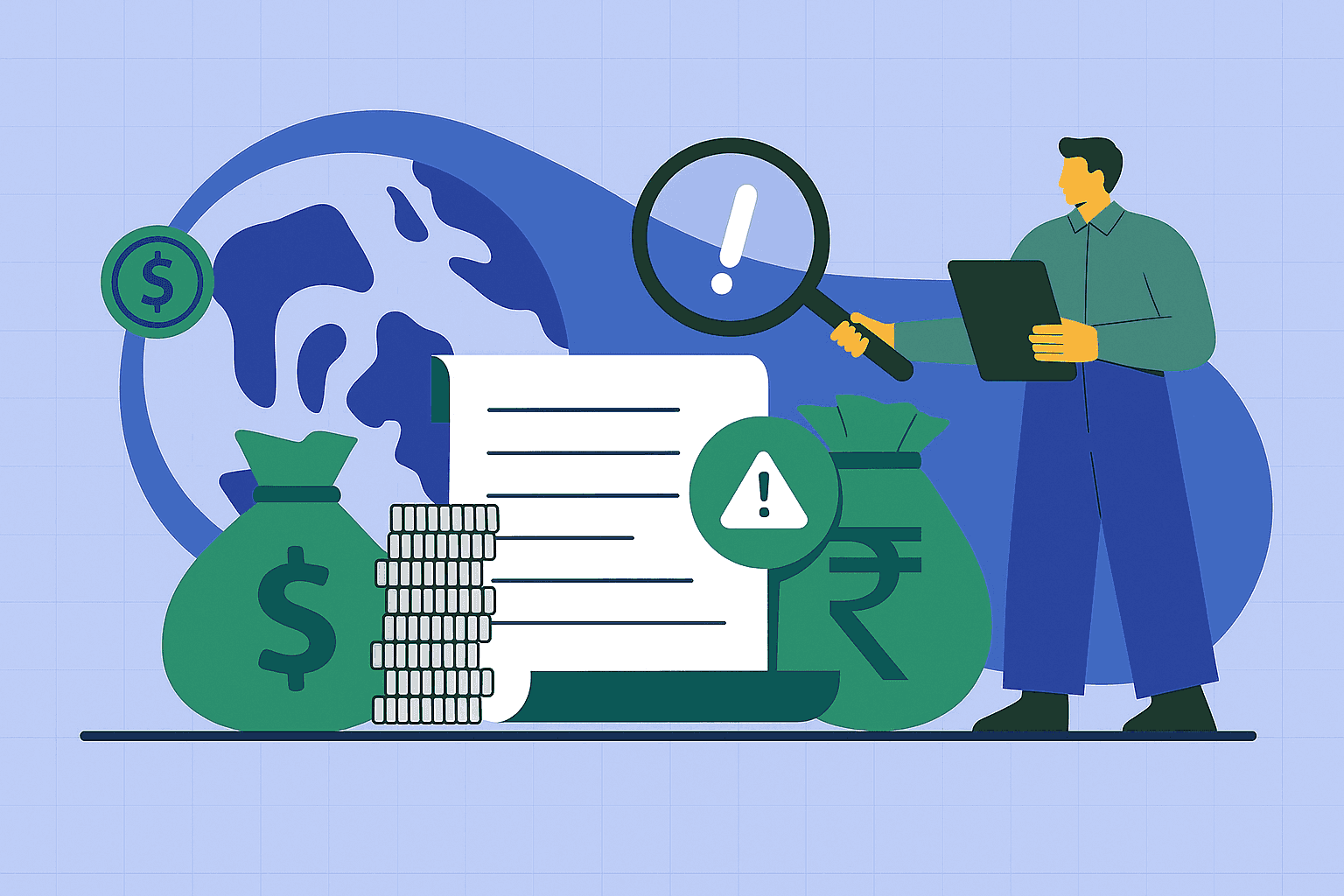
SOFTEX Not Filed on Time: Penalties, Fixes & 2026 Rules

TL;DR - Summary
- What is SOFTEX and when is the SOFTEX filing due? - SOFTEX is a mandatory export declaration form under the Foreign Exchange Management Act, 1999, for software or IT-enabled services delivered electronically, and the SOFTEX filing is due within 30 days of the invoice date.
- What happens if SOFTEX is not filed on time? - If SOFTEX is not filed on time, the export record stays open in EDPMS, the AD bank cannot close the transaction, and the FIRC cannot be issued until the record is regularized.
- What penalties apply when SOFTEX is not filed on time, and how do you fix a late filing? - A SOFTEX not filed on time can draw a penalty of up to three times the sum involved under Section 13(1) of FEMA, and you fix a late filing through condonation of delay, which the certifying authority can grant where the delay is for genuine reasons.
- Does the 2026 Export Declaration Form (EDF) transition cancel SOFTEX obligations that were not filed on time? - No, the 2026 EDF transition does not cancel pending or unfiled SOFTEX obligations, and filings due before October 1, 2026 must still be closed under the existing STPI/RBI framework.
What Is SOFTEX and Why Does the Filing Deadline Matter?
SOFTEX is a mandatory export declaration form issued under the Foreign Exchange Management Act (FEMA), 1999. Indian companies and freelancers use it to declare the export of software or IT-enabled services delivered electronically. It is essentially a digital shipping bill for invisible exports, since software leaves no physical trail at customs. The filing deadline matters because SOFTEX is the declaration that tells RBI an export happened.
The form does three jobs. It tracks foreign exchange inflows from software exports, enforces FEMA compliance by making sure exporters repatriate earnings within stipulated deadlines, and certifies export valuations to prevent illegal fund transfers.
Say a Bengaluru SaaS startup invoices a US client $5,000 for a software project delivered over the internet. No goods cross a port, so there is no shipping bill. The SOFTEX form is what tells RBI that the export happened and that the payment must come back within the allowed period.
What Actually Happens If SOFTEX Is Not Filed on Time?
When SOFTEX is not filed on time, the export record stays open in the Export Data Processing and Monitoring System (EDPMS). The AD bank cannot reconcile the inward payment against the invoice or close the record, and the Foreign Inward Remittance Certificate (FIRC) cannot be issued until the record is regularized. The remittance may also be treated as "general services" instead of export proceeds, and banks may impose account restrictions.
EDPMS is the RBI's monitoring backbone. It tracks every export transaction from declaration through payment realization to closure, so a missing SOFTEX leaves the transaction stuck partway.
- Open EDPMS entry: the export record stays open, and the AD bank cannot reconcile the inward payment against the invoice.
- FIRC blocked: the FIRC cannot be issued until the record is regularized, which blocks GST refund claims for software exporters.
- General services treatment: tGeneral services treatment: the remittance may be treated as "general services" instead of export proceeds.
- Possible account restrictions: banks may impose restrictions on accounts, including potential freezes, because of non-compliance with export documentation requirements.
The open-entry flag is the first consequence, and it isn't an automatic FEMA prosecution. That gives you a window to act before the matter escalates.
Check your EDPMS status with your AD bank the moment you realize a filing is overdue. The earlier you act, the shorter the escalation chain.

What Are the Penalties for Missing the SOFTEX Deadline?
The penalty for missing the SOFTEX deadline falls under Section 13(1) of FEMA, 1999, and can run up to three times the sum involved where that amount is quantifiable. A continuing contravention, where the violation persists day after day, can attract an additional daily penalty on top of the principal penalty.
- Legal basis: non-filing contravenes the Foreign Exchange Management (Export of Goods and Services) Regulations.
- Practical costs: beyond the statutory fine, you face an open export record in EDPMS, an AD bank that cannot close the transaction, and a FIRC that cannot be issued until the filing is regularized. All of these directly affect a services exporter's working capital.
- Filing deadline: SOFTEX is due within 30 days of the invoice date. For multiple invoices in a month, a consolidated filing is due within 30 days of the last invoice of that month.
- Payment window: the payment itself must also be realized within the permitted period, generally nine months from the date of export as of July 2026.
- Condonation: where the delay is due to genuine reasons, the certifying authority has the power to condone it, subject to conditions.
How Do You Fix a Missed SOFTEX Filing Through Condonation?
You fix a missed SOFTEX filing through condonation of delay. It is a formal process where you approach the certifying authority, explain the reason for the delay, and request that the late filing be accepted and regularized. The authority grants condonation where the delay is for genuine reasons, and it can attach conditions.
The process differs depending on whether you are an STPI unit or a non-STPI (Domestic Tariff Area, or DTA) unit. The comparison table in the next section shows who to approach in each case. The general steps are:
- Identify whether you are an STPI-registered unit or a non-STPI/DTA unit. This determines which authority you approach.
- Prepare a written request or application explaining the reason for the delay and the period of delay.
- Gather supporting documents: invoices, export agreements, proof of payment receipt, and any remittance documentation (FIRC/FIRA if available).
- Submit the application along with the late SOFTEX form and supporting documents to the appropriate authority.
- Wait for review and certification. Once certified, the certified SOFTEX copy goes to the AD bank for EDPMS reconciliation.
- Once the AD bank updates EDPMS and the payment is matched, the entry closes and the FIRC can be issued.
Timelines vary. Condonation cases may take longer depending on the authority's workload.
STPI vs Non-STPI Units: Who Do You Approach for Late Filing?
The authority you approach for a late SOFTEX filing, and for condonation, depends on how your unit is registered. STPI units approach the STPI software exports centre where the unit is registered, and STPI is their certifying authority. Non-STPI (Domestic Tariff Area) units approach their AD Category-1 (AD-1) bank. SEZ units route declarations through the Development Commissioner of the SEZ, not through STPI or the AD bank.
| Factor | STPI Unit | Non-STPI / DTA Unit |
|---|---|---|
| Who to approach | STPI software exports centre | AD Category-1 bank |
| Which form | SOFTEX (pre-Oct 2026) | SOFTEX (pre-Oct 2026) |
| Condonation authority | STPI | AD bank |
| Penalty exposure | Under FEMA Section 13(1) - up to 3x sum involved | Under FEMA Section 13(1) - up to 3x sum involved |
| Post-Oct 2026 route | STPI or AD bank (both now Specified Authority) | AD bank directly |
Under the 2026 regulatory framework, AD-1 banks are recognized as a "Specified Authority" on par with STPI. That means DTA software exporters can route their declaration, and a late filing, through their bank directly.
What Happens When SOFTEX Not Filed on Time Goes to RBI?
If an EDPMS entry stays open for an extended period without the exporter taking action, the AD bank is required to report it to RBI. At that point the matter moves from an administrative reconciliation issue to a potential FEMA enforcement matter, and your window to self-correct narrows significantly.
Ignoring an open EDPMS entry is the riskiest option. The escalation path runs from open entry to bank report, then RBI attention, then FEMA enforcement, and it is real and sequential.
The move from SOFTEX to the Export Declaration Form (EDF) doesn't wipe out existing SOFTEX filings or their EDPMS entries. They still need to be reconciled and closed in the normal course, and the AD bank continues monitoring them after the EDF regime takes over in October 2026.
💡 QUICK INSIGHT
The earlier you approach your bank or STPI for condonation, the more likely the matter stays at the administrative level and never reaches RBI.
Does the 2026 EDF Transition Cancel Your Pending SOFTEX Obligations?
No. The 2026 EDF transition does not cancel pending or unfiled SOFTEX obligations, and old obligations under the STPI/RBI framework still apply in full. The final notification, FEMA 23(R)/2026-RB, was gazetted on January 13, 2026, with an effective date of October 1, 2026. It replaces 167 existing circulars and supersedes the entire 2015 export framework, but it does not retroactively waive filings due before October 1, 2026.
Existing SOFTEX filings and their open EDPMS entries still need to be reconciled and closed in the normal course. The AD bank continues monitoring these entries even after EDF takes effect.
What Changes Under EDF From October 2026
- One form: every export, whether goods, services or software, uses a single unified Export Declaration Form.
- Specified Authority: AD-1 banks are recognized as "Specified Authority" alongside STPI.
- Monthly filing: the filing cycle moves to monthly consolidated filing, within 30 days of the month's last invoice, in place of per-transaction declarations.
- Realization windows: Under the updated 2026 framework, foreign-currency invoices carry a 9-month realization window, while INR-settled export contracts carry 12 months. Flag this internally.
- Payment chains: if you receive third-party or intercompany payments, document the payment chain carefully, as the AD bank's due diligence responsibility is increasing under the new framework.
⚠️ COMMON MISCONCEPTION
SOFTEX is being replaced by EDF in October 2026, but that does not mean your unfiled or late SOFTEX forms for past transactions are forgiven. Old obligations must still be closed under the existing STPI/RBI framework.
How Skydo Helps You Stay Ahead of SOFTEX Compliance?
The biggest documentation burden in a late SOFTEX or condonation case is proving that the payment came in. You end up gathering FIRC and FIRA copies, matching amounts to invoices, and showing the bank a clean remittance record. That is where Skydo fits in. It helps Indian software exporters and IT service providers receive international payments with a clean, automatic documentary trail, the kind that makes condonation submissions and compliance checks significantly easier.
- Free FIRC: Skydo issues a free FIRC certificate automatically for every inward payment, so your proof of payment is always ready without manual chasing.
- Free virtual accounts: available in USD, EUR, GBP, SGD, AUD, and CAD. Setup takes 10–15 minutes, so every inward payment is received into a structured, trackable account from day one.
- Flat, predictable pricing: under $2,000 is $19 flat, $2,000–$10,000 is $29 flat, and over $10,000 is 0.3%. There are no hidden fees and no monthly charges, and you pay only when you transact.
- EDPMS closure assistance: link your DGFT account once, then bulk-upload shipping bills to auto-map IRMs and generate eBRC in one click. This directly reduces the manual burden of keeping EDPMS entries clean.
If you want your compliance trail always complete, automatically, without scrambling when a bank or regulator asks, Skydo removes the documentation gap that leads to late filing crises in the first place.
What happens if SOFTEX is not filed?
If SOFTEX is not filed, the export record stays open in EDPMS, the AD bank cannot close the transaction, the FIRC cannot be issued, and the remittance may be treated as "general services" instead of export proceeds. Banks may also impose account restrictions. Under FEMA Section 13(1), the penalty can reach up to three times the sum involved, with an additional daily penalty for continuing contravention.
What is the SOFTEX filing due date?
Is SOFTEX filing mandatory?
What are the RBI guidelines on SOFTEX filing?